ResearchSunday, March 8, 2026

AI-Powered Commercial Laundry & Linen Services Marketplace

Unlocking a $12B fragmented market by connecting hotels, hospitals, and restaurants with verified laundry providers through AI-driven quality assurance and automated procurement.

1.

Executive Summary

The commercial laundry and linen services market in India represents a massive, highly fragmented opportunity valued at $12 billion annually. Hotels, hospitals, restaurants, and spas rely on linen services—but the industry remains dominated by local providers with no standardization, no quality benchmarks, and zero digital procurement.

This creates a perfect storm for a B2B marketplace: fragmented supply, inelastic demand, high repeat usage, and zero player has achieved meaningful scale. An AI-powered marketplace that handles vendor verification, quality scoring, automated scheduling, and smart procurement can capture this market piece by piece.

The timing is critical: post-pandemic hygiene standards have increased laundry volume by 40%, labor costs are rising 15% annually, and hotel chains are actively seeking vendor consolidation. The window for building the category-defining platform is NOW.

2.

Problem Statement

The Buyer Pain

Hotels & Restaurants:
  • No way to compare laundry vendors—rely on personal networks
  • Inconsistent quality—linen damage, stain issues, delays
  • Manual ordering via phone/WhatsApp—error-prone, no tracking
  • No visibility into pricing—vendors charge whatever market bears
  • Payment friction—COD dominance, no invoicing standardization
Hospitals & Healthcare:
  • Stringent hygiene requirements but no standardized compliance verification
  • Biohazard handling inconsistencies across vendors
  • No audit trail for infection control compliance
  • Emergency demand spikes handled poorly by current vendors
The核心 Problem: Every buyer manages this manually. Every transaction is a phone call. Every quality issue is a fight. There is no digital infrastructure connecting this $12B market.
3.

Current Solutions

CompanyWhat They DoWhy They're Not Solving It
Linen KingCommercial laundry for hotels in MumbaiRegional only, no tech platform, manual operations
UC CleanLinen rental + laundry for hotelsFocus on big chains, no SMB access
SpinbotsOn-demand laundry B2CB2C focus, not commercial
Wah cleanerB2C laundry startupConsumer focus, not enterprise
Local dhabas/karyana servicesInformal, unorganizedNo verification, no quality, no scaling

Market Gaps Identified

  • No centralized vendor marketplace — Buyers must source vendors manually
  • Zero quality standardization — No common benchmarking
  • No compliance infrastructure — Hospitals can't verify hygiene standards
  • Manual everything — Phone/WhatsApp ordering, no API integrations
  • No pricing transparency — Every deal is negotiated in isolation
  • Fragmented payments — COD dominates, no credit terms, no digital invoices
  • No inventory visibility — Hotels can't track linen cycles, turnover,损耗

  • 4.

    Market Opportunity

    Market Size

    • India Commercial Laundry Market: $12 billion (2025)
    • Global Commercial Laundry: $110 billion
    • CAGR: 8.5% through 2030
    • Organized Market Share: Less than 8% (huge fragmentation opportunity)

    Why Now

  • Post-pandemic hygiene surge — Hotels increased laundry volume 40%
  • Labor cost inflation — Minimum wage increases push businesses to outsource
  • Hotel consolidation — Chains seeking vendor partners, not individual vendors
  • Digital payment adoption — UPI enables B2B transactions
  • AI capability maturity — Computer vision for quality, NLP for voice orders
  • Supply chain digitization — Hotels/ restaurants adopting PMS (Property Management Systems)

  • 5.

    Gaps in the Market

    Using Anomaly Hunting—looking at what should exist but doesn't:

  • No vendor verification standard — Anyone with a washing machine claims to be a commercial laundry
  • No quality scoring system — No Yelp/Google Reviews equivalent for B2B laundry
  • No compliance certification — No verified hygiene badges, no ISO for laundry
  • No dynamic pricing — Flat contracts regardless of volume/urgency
  • No inventory tracking — Hotels don't know their linen utilization rates
  • No predictive ordering — Reordering is reactive, not data-driven
  • No consolidated supply chain — Hotels need sheets, towels, uniforms from different vendors
  • No B2B marketplace — No Amazon for commercial laundry services

  • 6.

    AI Disruption Angle

    Current State (Manual)

    Buyer → WhatsApp Vendor → Phone Call → Quote → Order → Pickup → Wash → Delivery → COD Payment → Repeat

    With AI Agents (Transformed)

    Buyer → AI Agent (voice/chat) → Auto-match vendor → Smart scheduling → Quality scoring → Auto-invoice → Net-30 payment → AI optimization recommendations

    AI Use Cases

    1. Computer Vision Quality Control
    • Scan linen for stains, tears, wear before/after processing
    • Score vendors on consistency
    • Auto-reject substandard batches
    2. Voice-First Ordering
    • "Hey AI, we need 200 towels by 6 AM"
    • Natural language order processing
    • Integration with hotel PMS systems
    3. Demand Forecasting
    • Predict laundry volume based on bookings/events
    • Pre-allocate vendor capacity
    • Reduce emergency surcharges
    4. Vendor Matching AI
    • Match buyer requirements (volume, quality, location, price) to vendor capabilities
    • Continuous learning from fulfillment data
    5. Intelligent Routing
    • Optimize pickup/delivery routes
    • Batch orders from nearby buyers
    • Reduce logistics costs by 30%

    7.

    Product Concept

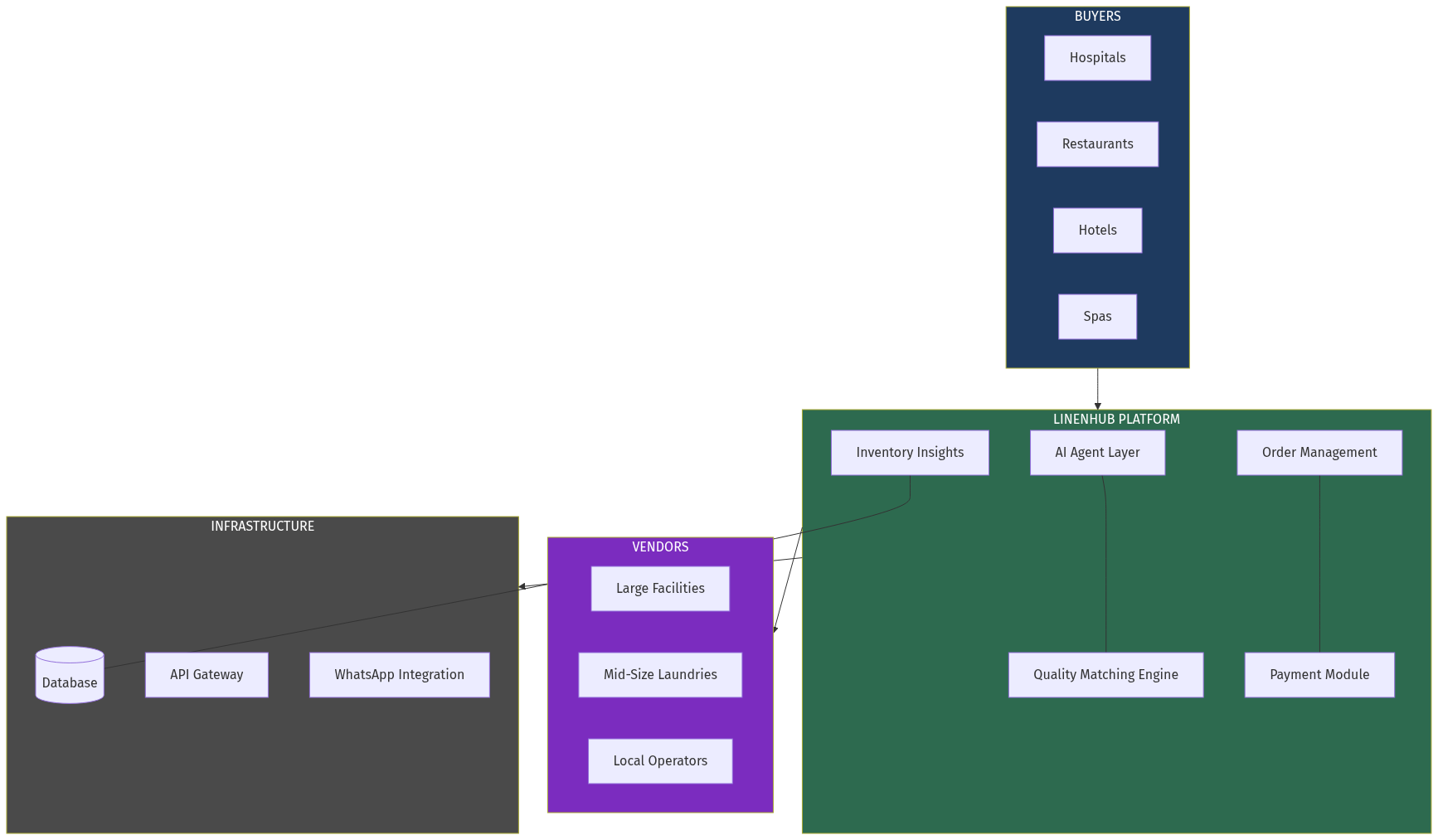
    Platform: LinenHub (or CleanB2B)

    Key Features

    For Buyers:
  • Vendor Marketplace — Browse, compare, book verified laundry vendors
  • Quality Dashboard — View vendor ratings, certification status
  • Smart Ordering — Voice/chat/email ordering with PMS integration
  • Live Tracking — Real-time pickup/delivery status
  • Auto-Invoicing — Digital invoices, payment tracking, credit terms
  • Inventory Insights — Linen utilization reports, replacement alerts
  • For Vendors:
  • Lead Generation — Automated buyer matching
  • Route Optimization — Smart pickup/delivery scheduling
  • Quality Toolkit — Photo scanning app for consistency
  • Financial Services — Instant payments, credit advances
  • Business Insights — Demand forecasting, pricing recommendations
  • Revenue Model

    StreamDescriptionTake Rate
    Transaction Fee8-12% on every orderPlatform revenue
    SubscriptionPremium features for buyers ($99-499/mo)SaaS
    Vendor ListingFeatured placement for vendorsAdvertising
    FinanceEmbedded lending for vendorsInterest spread
    Supply SalesSell linen, detergents to vendorsMarketplace
    ---
    8.

    Development Plan

    PhaseTimelineDeliverables
    MVP8 weeksVendor marketplace, basic ordering, WhatsApp integration
    V112 weeksQuality scoring, invoicing, vendor verification
    V216 weeksAI matching, route optimization, voice ordering
    Scale24 weeksMulti-city expansion, enterprise integrations

    MVP Features (Priority Order)

  • ✅ Vendor onboarding + verification
  • ✅ Buyer marketplace browsing
  • ✅ Order placement (WhatsApp-first)
  • ✅ Basic tracking
  • ✅ Rating/review system

  • 9.

    Go-To-Market Strategy

    Phase 1: Hospital Traction

    • Why: Highest pain, willing to pay, compliance needs
    • Tactics:
    1. Target mid-sized hospitals (50-200 beds) 2. Offer free compliance audit 3. Partner with hospital associations 4. Reference selling: one hospital → network

    Phase 2: Hotel Expansion

    • Why: Volume, repeat, organized decision-making
    • Tactics:
    1. Target 3-star hotels first (price-sensitive, less served) 2. Offer 30-day free trial 3. Integrate with Hotelogix, eZee PMS 4. List on hotel supplier directories

    Phase 3: Restaurant/Spa Scaling

    • Why: High volume, fragmented, price-driven
    • Tactics:
    1. Restaurant association partnerships 2. Group buying for volume discounts 3. Franchisee network targeting

    Channel Strategy

    • Direct Sales: Field sales for hospitals, hotels
    • Partnerships: PMS providers, hospital management companies
    • Digital: SEO for "commercial laundry [city]", LinkedIn for procurement managers
    • Events: Hotel/food industry exhibitions

    10.

    Revenue Model Details

    Transaction Economics (Illustrative)

    MetricValue
    Avg. Order Value₹15,000
    Platform Fee10% (₹1,500)
    Vendor Payout₹13,500
    Gross Margin10%
    Customer Acquisition₹2,000
    LTV₹180,000
    LTV:CAC Ratio90:1

    Revenue Projections (Year 3)

    SegmentGMVRevenue
    Hospitals₹40 Cr₹4 Cr
    Hotels₹60 Cr₹6 Cr
    Restaurants₹30 Cr₹3 Cr
    Total₹130 Cr₹13 Cr
    ---
    11.

    Data Moat Potential

    High moat potential over time:
  • Quality Database — Historical quality scores create vendor comparison advantage
  • Pricing Intelligence — Real-time market rates by city/segment
  • Demand Patterns — Seasonal booking data for predictive capacity
  • Vendor Performance — Proprietary vendor health scores
  • Buyer Preferences — Order history, quality sensitivity, price elasticity
  • Network Effects:
    • More buyers → more vendor demand → more vendors → better selection → more buyers
    • Data flywheel improves matching accuracy over time

    12.

    Why This Fits AIM Ecosystem

    Vertical Fit

    • B2B marketplace: Core AIM capability
    • Workflow-driven: Perfect for AI agent automation
    • Offline-heavy: Linen services are physically local—matching AIM's location intelligence
    • Fragmented supply: 1000s of small vendors—no dominant player

    Integration Opportunities

    • AIM.in: Directory of industrial service providers
    • WhatsApp commerce: Natural ordering channel for Indian SMBs
    • Payments: UPI integration for instant settlements
    • Domain strategy: linen.in, laundry.in, hospitalitysupplies.in

    Cross-Sell Potential

    • Expand to uniform manufacturing → corporate apparel
    • Hotel supplies marketplace → extend beyond laundry
    • Kitchen equipment → natural adjacent category

    13.

    Mental Model Analysis

    Zeroth Principles

    • What if there were no "laundry vendors"? Would hotels do it themselves? (Most don't—they outsource)
    • What if linen was a service, not a product? (Netflix model: pay per use, not ownership)

    Incentive Mapping

    • Who profits from chaos? Local vendors with no accountability
    • Who benefits from standardization? Hotels (lower cost), buyers (quality), but vendors (less pricing power)
    • What's keeping this fragmented? No capital investment needed, low barriers, cash flow is immediate

    Falsification (Pre-Mortem)

    Assume 5 well-funded startups failed in this space. Why?
  • Quality is subjective — Buyers can't measure, vendors game the system
  • Logistics are hard — Pickup/delivery is expensive, low margins
  • Vendors don't want to be disintermediated — They lose direct client relationships
  • Buyers are sticky — Once vendor works, they don't switch
  • Price wars — Race to bottom on fees
  • Steelmanning (Why Incumbents Might Win)

    • UC Clean has relationships with Taj, ITC
    • Linen King has decade of operational expertise
    • Regional players have local logistics advantage
    • Capital-intensive: washing machines, logistics trucks require heavy investment

    ## Verdict

    Opportunity Score: 7.5/10

    This is a real market with real pain and no dominant player. The timing is favorable (digital adoption, post-pandemic hygiene focus). AI can solve real problems (quality scoring, voice ordering, route optimization).

    The Catch: Execution is hard—logistics, vendor relationships, quality control are all operational heavy. This is not a pure software play; it requires ground game. Recommendation: Build as a hybrid marketplace + managed services. Start with ONE city (Bangalore or Delhi-NCR), prove unit economics, then scale. Target 3-star hotels first—they have volume but less bargaining power than 5-star chains.

    The market is waiting for a category-defining platform. Someone will build it. Why not us?


    ## Sources


    Workflow Diagram
    Workflow Diagram

    Platform Architecture

    Architecture Diagram
    Architecture Diagram